
Who Ate All This Rice?
A funeral, one empty pot, and the expensive lesson the Mambudzi family did not see coming
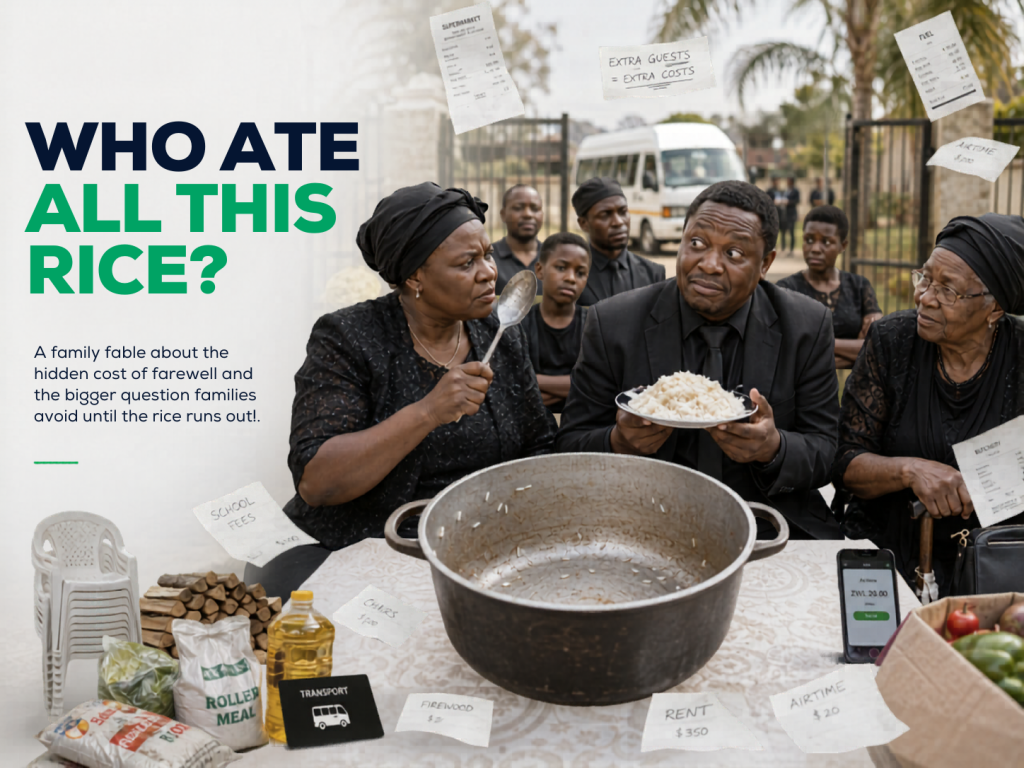
When Auntie Rudo found the empty pot, the Mambudzi funeral stopped being a funeral and became an investigation.
She stood behind the catering table with one hand on her waist and the other holding a serving spoon like a police exhibit. In front of her was a 20-litre pot that, just moments earlier, had been full of rice. Not ordinary rice. Rice with status. Rice that had arrived at the funeral in stainless steel catering dishes, carrying the full ambition of a family that wanted the entire ghetto to know that zvavo zvakarongeka.
Now the pot was empty.
Not low.
Empty.
Three grains sat at the bottom, looking traumatised.
Auntie Rudo lifted the lid and checked again, as if perhaps the rice had hidden underneath itself. Then she turned slowly towards the tent, where mourners were eating with the deep concentration of people who had suddenly remembered that grief requires a second helping.
“Who,” she asked, her voice calm in a dangerous way, “ate all this rice?”
At the gate, Uncle Jabu froze. His plate was carrying a mountain of rice, two pieces of chicken, salad, and the kind of soup arrangement that required engineering approval.
“This is not mine,” he said quickly.
Auntie Rudo stared at him.
“Whose is it?”
“For Gogo.”
“Why is Gogo’s rice mounted on two drumsticks when she can’t chew?”
Uncle Jabu looked at the sky, hoping an ancestor would testify on his behalf.
None came.
The meeting where rice became policy
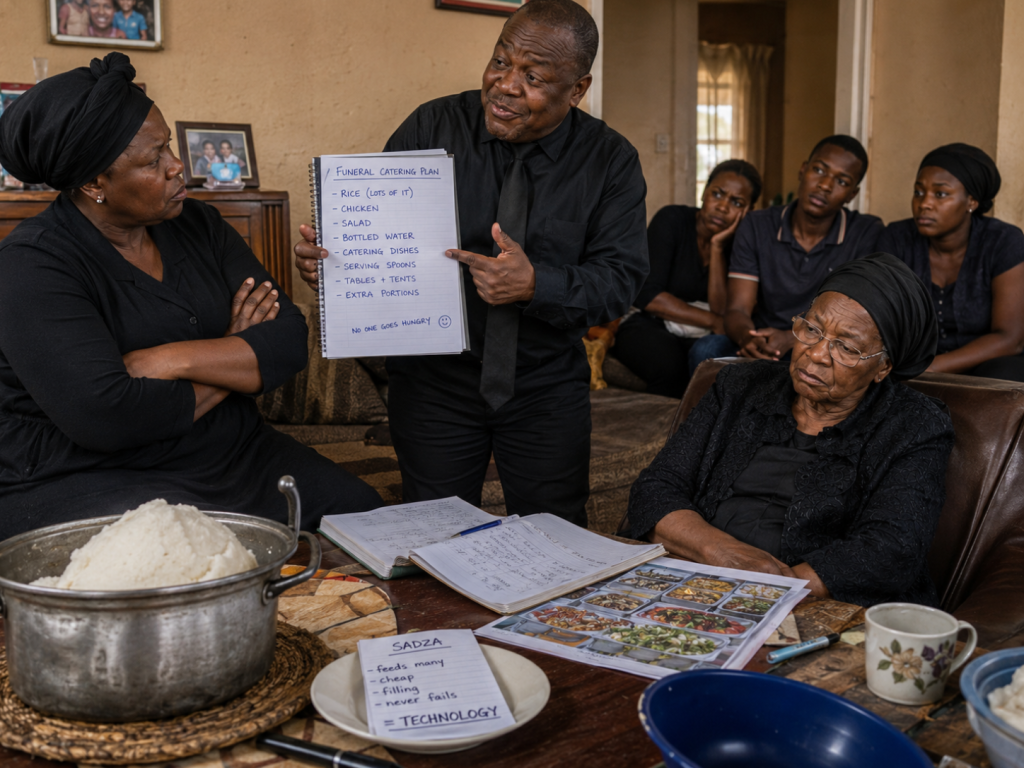
To understand how the Mambudzi family got there, one must go back to the planning meeting, where all bad ideas begin politely.
Three days earlier, Uncle Jabu had stood in the lounge and announced that the funeral would not be handled “like those other funerals.”
“What other funerals?” Gogo asked.
“You know,” he said, waving his hand in the direction of society. “Those funerals where people are just moving around with buckets and someone is shouting, ‘Who has seen the plates?’”
Auntie Rudo narrowed her eyes. “That is called community.”
“No,” said Jabu. “This time, we do catering. Proper catering. Uniforms. Stainless steel. Rice. Chicken. Salad. Bottled water.”
At “bottled water,” Gogo removed her glasses.
“Bottled water? At a funeral? Jabu, even sorrow can drink council water.”
But Uncle Jabu had already entered the dangerous spiritual condition known as wanting the ghetto to see. He had seen the mourners arriving, looking around, whispering, “Ah, the Mambudzis have arrived.” He had imagined the neighbours reporting that even in grief, the family had tablecloths.
“What is wrong with sadza?” Auntie Rudo asked.
Jabu smiled with the confidence of a man about to insult a national institution.
“Sadza is too ordinary.”
The room went cold.
Gogo leaned forward. “My son, sadza reparufu is not ordinary. Sadza is technology.”
“Technology?”
“Yes. Crowd-control technology. Budget-control technology. Hunger-management technology. Sadza enters the stomach and tells appetite, ‘This meeting is adjourned.’”
Auntie Rudo nodded. “Sadza has discipline.”
But Jabu had been seduced by rice. Rice looked modern. Rice looked premium. Rice looked like progress. So the family agreed, not because they believed him, but because he had already paid the caterer a deposit — and in Zimbabwe, many mistakes become policy once money has left the account.
The day the ghetto noticed
On the day of the funeral, the ghetto noticed immediately.
The catering team arrived in matching shirts and shiny confidence. By ten o’clock, neighbours were passing by “just to greet.” By eleven, someone had reported that the Mambudzis were serving rice. By midday, attendance had improved mysteriously.
Some people came to mourn. Some came to support the family. Some came because death reminds us of community. And some came because someone had whispered, “Ikoko kune catering.”
At first, Uncle Jabu was triumphant.
“You see?” he told Auntie Rudo. “Standards.”
Then people started coming back to the serving table.
Once.
Twice.
A third time with different body language.
Rice, the Mambudzis soon discovered, is not like sadza. Sadza arrives on a plate like a senior relative. You respect it. You negotiate with it. You know when you are defeated. Rice, however, behaves like a snack in formal wear. People eat it, stand up, discuss exchange rates for four minutes, and return convinced they have not eaten properly.
By 2:47pm, the pot was gone.
Then, as if the day had not been humbled enough, a bus from Mutare arrived.
It was full in the Zimbabwean sense of the word: relatives, half-relatives, neighbours of relatives, and one man nobody knew but who greeted everyone with the confidence of a person who had attended the family tree personally.
The first question from the bus was immediate.
“Pane zvekudya here?”
Auntie Rudo looked at the empty pot. Uncle Jabu looked at the caterer. The caterer looked at the invoice. Gogo looked at Uncle Jabu with the expression of a woman watching prophecy fulfil itself.
No one said it, but everyone heard it:
Sadza would not have done this to us.
More rice had to be bought. Then more relish. Then more plates, because the first plates had disappeared with people who were “coming back just now.” Then extra chairs. Then airtime for the chair man. Then fuel for the chair man, who was “almost there,” meaning he was still at home looking for socks. Then transport money for someone who had come to comfort the family but now needed comforting with bus fare.
The rice was not the problem
By sunset, nobody was asking who ate the rice anymore.
The rice was not the problem.
The rice was the whistleblower.
It had exposed the hidden economy of a funeral: the food, transport, fuel, airtime, extra people, return fares, family obligations and small emergencies that arrive without warning and demand to be paid immediately.
The Mambudzis had prepared for the visible event. They had not prepared for everything the event would drag behind it.
That is where funeral cash cover matters.
A funeral services arrangement may help with the rites and logistics of burial. Those are important. But families often need money in hand for the surrounding pressure: the food, movement, relatives, urgent extras and practical costs that do not sit neatly inside the ceremony.
A funeral cash plan such as Gadziriro/Lungiselelo is designed for that immediate mess, helping a family manage the financial pressure around the farewell, not only the formal act of saying goodbye.
Then life arrives with its own plate
Later that evening, after Uncle Jabu had been accused six more times of eating with executive appetite, Gogo called the family under the tree.
“The rice has embarrassed us,” she said. “But it has also educated us.”
Jabu opened his mouth.
Gogo raised a finger.
He closed it.
“Today we thought the problem was food. Then we realised the problem was planning. But listen carefully: after the tent comes down, another bill arrives. Life.”
The yard became still.
“School fees will come. Rent will come. Groceries will come. Debt will come. Children will still grow. The household will still need money. The person we have lost may be gone, but the life they helped carry will continue.”
And there, in the quiet after the comedy, the real lesson stood up.
Funeral cover helps with the immediate pressure around the farewell. Life insurance helps with the longer pressure after the farewell, when the family must continue without the person they depended on.
One helps when people gather.
The other helps after they leave.
Looking organised is not the same as being prepared
The next morning, Uncle Jabu sent a message to the family WhatsApp group.
“Good morning family. Yesterday I learnt that looking organised and being prepared are not the same thing.”
Three people left the group immediately.
The cousin in the UK muted it until 2099.
Auntie Rudo replied, “If this is about contributions, start with yourself.”
Jabu typed for a long time.
“No. I mean we need proper planning. Funeral cash cover for the immediate costs. Life insurance for the life after. We cannot keep using rice committees as financial strategy.”
Gogo replied, “Correct.”
Then, after a pause, she added, “Also, Jabu ate the rice.”
The group exploded.
Jabu protested until lunch.
Nobody believed him.
And that is how the Mambudzi family became famous in the ghetto. Not for the catering. Not for the tablecloths. Not even for the bottled water that Gogo still considered an insult to common sense.
They became famous for the rice.
But beneath the laughter, the lesson stayed: sometimes the visible cost is only the thing that exposes the real cost.
And sometimes the question is not really, “Who ate all this rice?”
It is: who told us rice was the only thing to count?
Plan for the farewell. Plan for the life after.
Funeral cover and life insurance are not the same thing. Funeral cover helps with the immediate costs and pressure around the farewell. Life insurance helps protect the family’s financial future after the farewell.
With Gadziriro/Lungiselelo, families can plan for the immediate financial demands that come with a funeral.
With Security Plan and LifeCare, families can think beyond the day people gather, and plan for the life that continues after everyone has gone home.
Because sometimes the real cost is not the rice.
It is everything the rice reveals.

